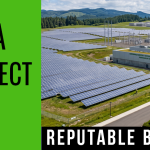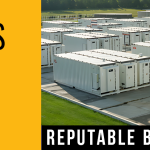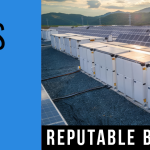
 The supplier of what has been touted as “one of the largest” grid-connected batteries in the world, to be installed alongside the 200MW Solar River Project in South Australia, has been revealed as GE Renewable Energy.
In an announcement on Thursday, GE said it had been selected to supply and integrate a 100MW/300MWh big battery for the 200MW solar PV plant.
By our calculations, if built now, it would be the biggest lithium ion battery in the world, besting the Tesla big battery at nearby Hornsdale which stands at 100MW/129MWh. However, other big batteries may beat it to the title before it is completed as several are under construction in the US.
Construction of the Solar River Project is due to get underway by Christmas this year, after its developers snared a power purchase agreement with major utility, Alinta Energy.
That deal, announced in July, locked in finance for the $480 million project, which is being developed by Jason May and Richard Winter near Robertstown, in South Australia’s mid-north, the starting point for the proposed new inter-connector to NSW.
The company has not disclosed the financial details of the 15-year PPA, but told RenewEconomy at the time that the deal with Hong Kong-owned Alinta was for 75 per cent of the solar farm’s output, making Solar River “very bankable.”
At that time, the supplier of the battery system remained a mystery, but May, who is the Solar River Project CEO, suggested the decision had already been made.
“This is the first purpose-built PV battery system in the world,” he told RE. “It’s never been deployed before, but because of who (the company supplying the battery) are, it can be banked.”
In comments this week, May said locking in GE as the supplier of the big battery system marked another major milestone for the project.
“General Electric is a world leader in renewable energy storage technology… (and) brings a cutting-edge technology to South Australia, by delivering huge energy transfer capacity with an intelligent operating system,” May said.
read more The world has watched on as some of its leading regional markets, China, South Korea, Australia, Japan, parts of the US, the UK, and many parts of Europe have raced ahead in deploying energy storage in the last five years, mostly, but not only, lithium-ion batteries. IHS Markit says that the US in 2019 will deploy around 712MW, becoming the world’s largest market for grid-connected batteries this year, while another research firm, Wood Mackenzie Power & Renewables, has predicted that 4.3GW could be installed worldwide during 2019.
 Last week, the city of Los Angeles inked a deal for a solar-plus-storage system at a record-low price. The 400-MW Eland solar power project will be capable of storing 1,200 megawatt-hours of energy in lithium-ion batteries to meet demand at night. The project is a part of the city’s climate commitment to reach 100 percent renewable energy by 2045.
 Additions of new residential energy storage capacity in the United States reached a record high in the second quarter of the year, exceeding 30 MW, a new report by Wood Mackenzie says. The market for energy storage in the country is growing fast, the authors note, driven by customer interest and government incentives.
 Enwave Australia has been appointed by the Western Australian Government to develop Australia’s first ever industrial renewable energy microgrid at the Peel Business Park in Nambeelup.
 A centralized power source can create issues when it unexpectedly goes offline. When a glitch led the Montclair State University’s (MSU) state-of-the-art microgrid to realize that an outage had occurred, it kicked in and isolated the University from the main grid , fired up its generators and seamlessly powered the entire campus for nine hours. MSU became an island.
 Germany must embrace renewables and energy storage at an unprecedented scale if it hopes to offset the void left behind by coal and nuclear phase-outs, a new study has said.