
Fractal Model
Investment-Grade BESS Analysis Software
Simulate performance, degradation, warranty, costs and revenues to optimize the economics of energy storage and hybrid projects.
One Tool for Every Configuration
The Fractal Model is a technoeconomic energy storage modeling package used in project development, due diligence and RFP evaluation.
From standalone BESS to complex hybrid portfolios, it delivers high-fidelity simulations of CAPEX, OPEX, cash flows, performance, degradation and warranty impacts, and can optimize the economics of any asset stack. It runs on Fractal’s cloud-based optimizer and integrates with Fractal’s Excel financial models and dashboards.


One Tool for the Entire BESS Lifecycle
Project visibility and optimal outcomes from development through operations.
Project Development
Maximize long-term returns with precision engineering and financial foresight. Use the Fractal Model for pre-construction design, investment-grade analysis and granular sensitivity testing. Integrated mapping tools and proprietary revenue forecasts identify high-potential sites and optimize system sizing for merchant and contracted business models, whether you are defining your offtake structure or refining system specs.
RFP Evaluation
Uncover the true cost of ownership through granular bid comparison. Standardize your evaluation by quantifying the full spectrum of CAPEX and OPEX, going beyond the sticker price to the long-term costs of auxiliary loads, degradation, warranty constraints and performance guarantees. Identify the solution with the lowest total cost of ownership and the highest reliability.
Due Diligence and M&A
De-risk investments with rigorous, transparent stress testing. Validate financial assumptions and assess the long-term impact of merchant revenue volatility. Stress test base-case pro formas to quantify risks and identify hidden upside, and optimize design and dispatch options during the acquisition phase.
Dispatch Optimization
Capture market upside without compromising asset health. Simulate the physical and financial impacts of new or modified dispatch strategies for operating BESS assets. The sub-hourly optimization engine balances ancillary services with day-ahead and real-time energy and capacity markets, modeling the trade-offs between revenue capture and battery degradation.
Features Designed for Analysts and Investors
The Fractal Model co-optimizes the technical design and financial analysis of storage and hybrid projects.
Transparent and Auditable
No black box. The Fractal Model uses Microsoft Excel with unlocked, auditable calculations and algorithms. Customize formulas and add your own cash flow, or use Fractal’s cash flow model.
Fast and Powerful
Inputs range from seasonal (12 months x 24 hours) to hourly (8,760 hours x 40 years). The Fractal Model Add-in is 20 times faster than VBA and automatically optimizes dispatch using hourly and 15-minute prices.
Unmatched Physics Engine
Accurately simulates efficiencies (user-configurable curves), degradation (six chemistries plus user-defined), auxiliary load, throughput and state of charge, tracking battery energy timestamp by timestamp.
Established
An established technoeconomic model in the energy industry, used for project development, due diligence, project finance and tax equity. The Fractal team has a six-year track record of project design and analysis with it.
Design and Dispatch Flexibility
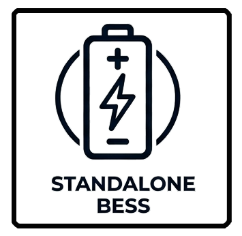
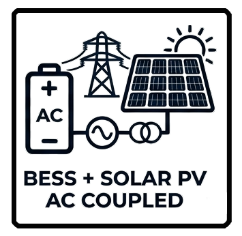
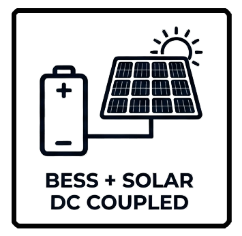
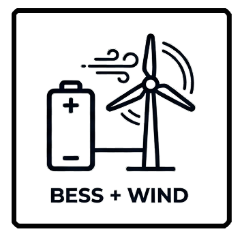
Design and analysis for standalone BESS or hybrid resources: PV plus storage (AC- or DC-coupled), wind plus storage and gas plus storage. Projects can be FTM or BTM, with merchant, full offtake or quasi-merchant dispatch.
Accurate Costs
The only tool that models CAPEX, OPEX and degradation according to real market data. Fractal aggregates project costs quarterly from procurements across different sizes, technologies and CODs.
Unlimited Revenue Streams
Analyze individual revenue streams or combinations, including partial or full PPAs, tolls and ESSAs. Model primary, secondary and tertiary revenue from wholesale markets, retail energy and demand charge offsets.
Multiple Technologies
Benchmark projects across LFP, NMC, LTO, flow, zinc aqueous and sodium sulfur batteries, each with built-in degradation curves and losses.
Unlimited Applications
Evaluate standalone or stacked services: energy arbitrage, ancillary services, renewable integration, solar smoothing and firming, capacity and resource adequacy, load following, peak shaving and clipped solar recapture, all within the asset’s usable energy and SOC limits.
State Programs
Built-in analysis of state storage programs, including CA SGIP, MA SMART, NY VDER, MA Clean Peak Energy Standard, MA/RI ConnectedSolutions, NY and IL Indexed Storage Credits, NJ GSESP, MA Section 83E, MD storage capacity credits and ME storage procurement. Users can also create custom programs.
Training and Support
Consult energy storage experts for quick questions, educational sessions, model setup or comprehensive analyses. Training is included with every subscription, with tutorial videos and FAQs in the user portal.
Global Markets
Built-in functionality for all North American ISOs and RTOs, customizable for European and Asia Pacific markets. Our team can quickly adapt the models to emerging markets.
Unleash the Power With the Fractal Model Add-in
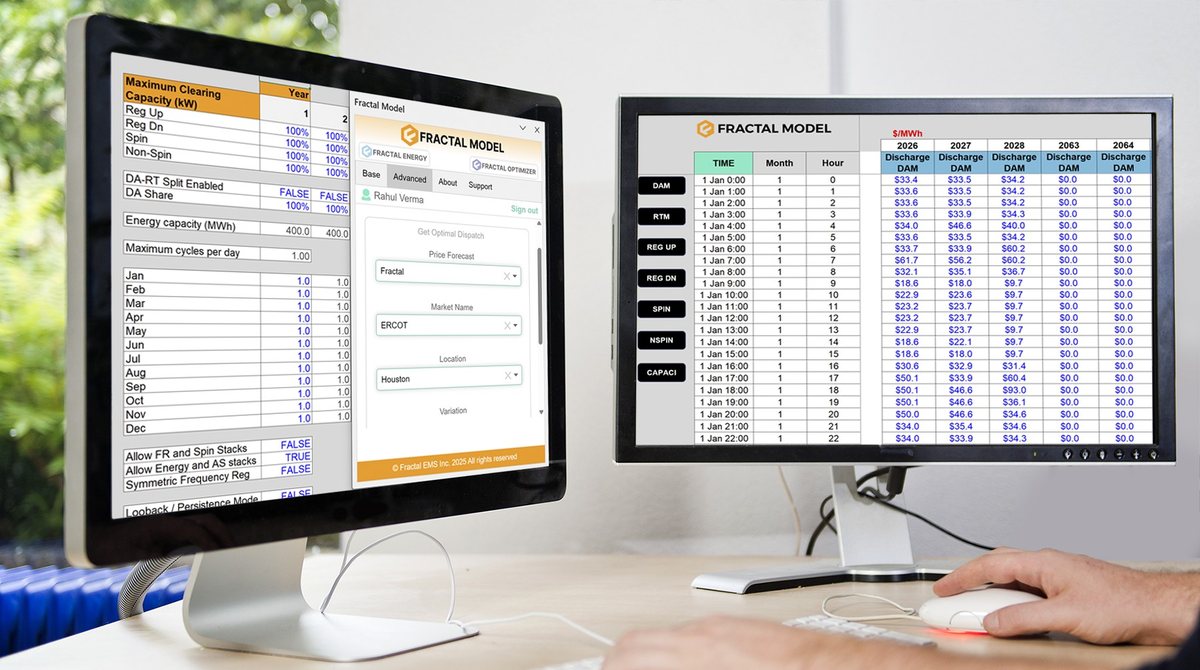
The Fractal Model integrates with Fractal’s cloud-based optimizer through a Microsoft 365 Add-in, with multiple calculation modes based on precision and use case.
- Sensitize intra-day market participation across six market services
- Test market prices, dilutions and custom trading strategies
- Vary market deployment assumptions and forecast risk management
- Optimize dispatch on hourly and 15-minute prices
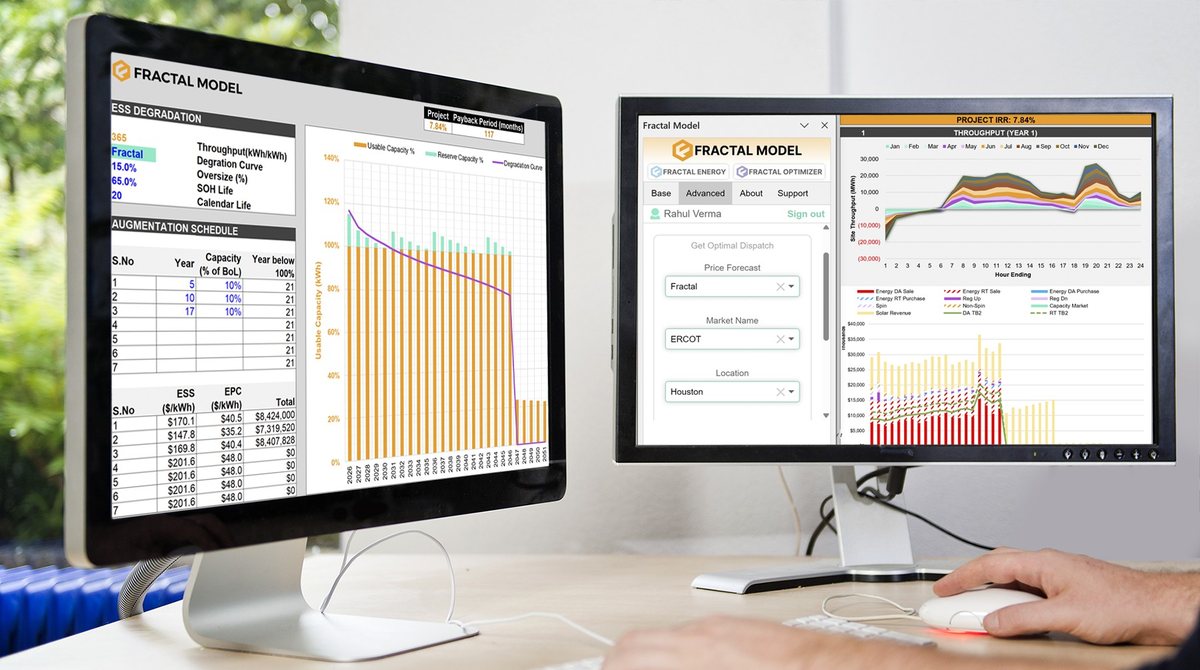
Investment-Grade Analysis
The financial model generates detailed cash flow results used for investment analysis worldwide.
- Tax equity cash flow, back leverage and construction loans
- Sensitivities on escalators for capacity, arbitrage and ancillary revenue, warranty, auxiliary load and corrective maintenance
- State programs such as CA SGIP, MA SMART, NY VDER and NJ GSESP, or your own custom program
Analyze Unlimited Revenue Streams
Model contracted revenue, merchant upside and incentives together, within the battery’s losses, degradation, auxiliary load and warranty limits.
Merchant
Fully exposed to market prices, with the highest potential IRRs and the most risk.
- Energy arbitrage (DA / RT). Buy low and sell high. Hedge positions on forecasts in day-ahead markets, and capture sudden price spikes from grid stress or renewable intermittency in real-time markets.
- Ancillary services. Each market offers its own blend of services, with unique qualification and participation requirements, clearing prices, physical obligations and competition.
- Capacity markets. Payments for being available to ensure grid reliability, such as PJM’s RPM or ISO-NE’s Forward Capacity Market, often assessed through capacity accreditation or ELCC.
Fully Contracted
Preferred by conservative investors and financiers seeking stable returns.
- Resource adequacy contracts. Load-serving entities pay a fixed monthly capacity payment ($/kW-month) for the battery’s net qualifying capacity during peak or slice-of-day hours.
- Tolling agreements. An offtaker pays a fixed capacity charge for exclusive rights to charge and discharge the battery. They take the market risk; you take the operational risk.
- Energy storage service agreements. Similar to a PPA, the offtaker pays for services provided by the BESS, often with performance guarantees for throughput and efficiency.
Quasi-Merchant
Satisfies bankability requirements while keeping a foot in the merchant door.
- Split capacity. Contract part of the output, such as 50%, to a utility at a fixed price and trade the rest in the merchant market.
- Merchant tail. Fully contracted for the first 10 to 12 years to pay off debt, then merchant for the rest of the asset’s useful life.
Hedges and Insurance
Third-party financial products that floor the downside.
- Revenue floor / revenue exchange. A bank or insurer guarantees a minimum annual revenue. If the market underperforms they pay you; if it outperforms, you share the upside.
- Insurance put. Protects against low-volatility years. Since batteries thrive on price spreads, the put pays out if spreads stay below a set threshold.
Real-World Analysis for an Evolving Energy Landscape
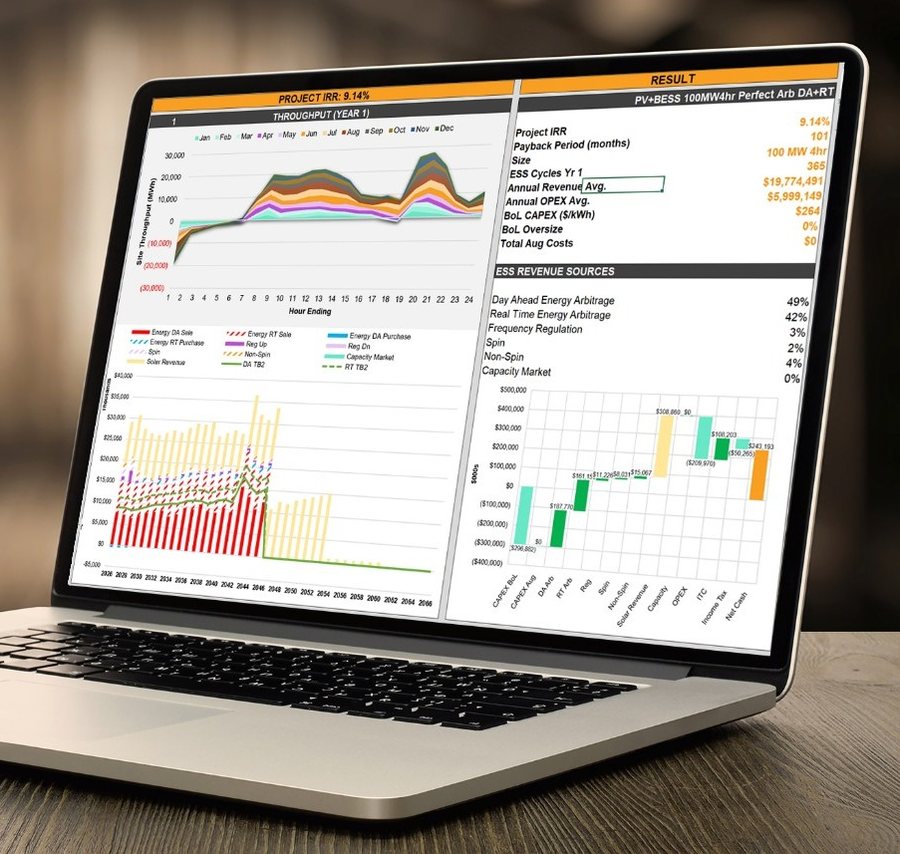
The Fractal Model co-optimizes battery degradation and physical constraints with ISO-specific revenue streams. By simulating dispatch at 5-minute and hourly intervals, it delivers the high-resolution, transparent data and sensitivity analysis lenders and equity partners need to de-risk merchant storage investments.
Select a market to see the revenue streams the model covers, as of 2026.
ERCOT8 revenue streams
- Arbitrage (RT & DAM). Profit from the price spread between charging at low prices and discharging during peaks; settled at nodal LMP in 5-min (RT) and hourly (DAM) intervals; paid in $/MWh.
- Reg Up (RT & DAM). Sub-min adjustments to increase frequency via AGC; now co-optimized every 5 min in RT; paid in $/MW-h.
- Reg Down (RT & DAM). Sub-min adjustments to decrease frequency via AGC; now co-optimized every 5 min in RT; paid in $/MW-h.
- RRS (RT & DAM). High-speed frequency response for sudden contingencies; now cleared in both DAM and RT co-optimization; paid in $/MW-h.
- FFR (RT & DAM). A sub-type of RRS providing sub-second response to frequency deviations; cleared in both DAM and RT; paid in $/MW-h.
- ECRS (RT & DAM). 10-min ramping product to handle net-load ramps and sustained frequency events; cleared in both DAM and RT; paid in $/MW-h.
- Non-Spin (RT & DAM). 30-min response for longer-duration contingencies or forecast errors; cleared in both DAM and RT; paid in $/MW-h.
- DRRS (RT & DAM). Implementation targeted for Late 2026. 30-min offline-to-online reliability product to reduce RUC instructions; expected to clear in both DAM and RT; paid in $/MW-h.
PJM5 revenue streams
- Arbitrage (RT & DAM). Managing congestion across the RTO; settled at nodal LMP in 5-min (RT) and hourly (DAM) intervals; paid in $/MWh.
- Reg Service (RT). Consolidated Phase 2 Design (2025/26). Fast-responding frequency signal following a single bi-directional AGC signal (RegD signals were consolidated); paid a capacity price in $/MW-h + mileage (performance) credits.
- Synchronized Reserves (RT). 10-min contingency response from online resources; now cleared every 5 min and co-optimized with energy; paid in $/MW-h.
- Secondary Reserves (RT). 30-min response product for grid stabilization and longer-duration contingency recovery; cleared in RT every 5 min; paid in $/MW-h.
- RPM Capacity Market (Auction). Annual payments for peak availability; cleared through the BRA and IA; payments based on ELCC accreditation; paid in $/MW-day.
ISO-NE5 revenue streams
- Arbitrage (RT & DAM). Shifting offshore wind and gas-constrained power; settled at nodal LMP in 5-min (RT) and hourly (DAM) intervals; paid in $/MWh.
- Reg (RT). AGC for frequency stability; resources follow a 4-second signal; paid a capacity clearing price in $/MW-h + service (performance) credits.
- DAAS. Replaced the Forward Reserve Market on March 1, 2025. Daily procurement of 10-min and 30-min reserves (TMSR, TMNSR, TMOR) to bridge the “uncertainty gap” between day-ahead and RT; paid in $/MW-h.
- Forward Capacity Market (FCA) (Auction). Annual payments for capacity cleared 3 years in advance to ensure long-term reliability; paid in $/kW-month.
- ConnectedSolutions (VPP). Distribution-level performance payments for summer/winter peak shaving via utility-administered battery programs; paid in $/kW-performance.
NYISO5 revenue streams
- Arbitrage (RT & DAM). Balancing upstate renewables and Canadian imports against downstate load centers; settled at nodal LBMP in 5-min (RT) and hourly (DAM) intervals; paid in $/MWh.
- Reg Service (RT). Sub-min frequency management via AGC; resources follow a high-speed signal; paid a capacity clearing price in $/MW-h + performance movement (mileage) credits.
- Operating & Uncertainty Reserves (RT & DAM). Includes 10-min (Spin/Non-Spin) and 30-min reserves, plus the newly deployed Uncertainty Reserve product to handle renewable forecast errors; co-optimized with energy; paid in $/MW-h.
- ICAP Capacity Monthly. Payments to ensure local and statewide reliability; based on seasonal CAF that de-rate nameplate MW; influenced by the “CHPE-Out” reliability parameters for 2026; paid in $/kW-month.
- ISC (Contracted). A 15-year revenue floor provided by NYSERDA for awarded projects; settled as the difference between a strike price and a Reference Price (composed of energy arbitrage and capacity values); paid in $/MWh.
MISO5 revenue streams
Footprint. Arkansas, Illinois, Indiana, Iowa, Kentucky, Louisiana, Michigan, Minnesota, Mississippi, Missouri, Montana, North Dakota, South Dakota, Texas, Wisconsin, and Manitoba (Canada).
- Arbitrage (RT & DAM). Managing regional wind-rich (North) and solar-heavy (Central) zones against a thermal-heavy South; settled at nodal LMP in 5-min (RT) and hourly (DAM) intervals; paid in $/MWh.
- Reg Reserve (RT & DAM). Real-time frequency following via AGC; procurement targets were increased to 600 MW+ in 2026 with dynamic hourly requirements to handle steeper solar ramps; paid in $/MW-h.
- Spin & Supplemental Reserves (RT & DAM). 10-min and 30-min contingency products; prices are now heavily influenced by a $10,000/MWh Value of Lost Load (VOLL) scarcity cap; paid in $/MW-h.
- STR (RT & DAM). Expanded to DAM in late 2025. A 30-min flexibility product designed to handle net-load forecast errors and sudden wind/solar drops; now clears in both markets to ensure “deliverability” before the operating hour; paid in $/MW-h.
- PRA (Seasonal). Capacity payments cleared through a four-season auction (Summer, Fall, Winter, Spring); based on Accredited Capacity (SAC) which de-rates batteries based on historical performance during “Risky Hours”; paid in $/MW-day.
SPP5 revenue streams
Footprint. Arkansas, Iowa, Kansas, Louisiana, Minnesota, Missouri, Montana, Nebraska, New Mexico, North Dakota, Oklahoma, South Dakota, Texas, and Wyoming.
- Arbitrage (RT & DAM). Managing renewable curtailment and steep ramps in the central wind corridor and newly integrated Western footprint; settled at nodal LMP in 5-min (RT) and hourly (DAM) intervals; paid in $/MWh.
- Reg Up/Down (RT & DAM). Core frequency response following AGC signals; now co-optimized across the expanded East and West Balancing Authorities; paid in $/MW-h.
- Spin & Supplemental Reserves (RT & DAM). Standard 10-min contingency products; cleared in both markets; paid in $/MW-h.
- Uncertainty Product (RT & DAM). Formerly known as Ramping Capability. A product designed to handle net-load and renewable deviations over 30-to-60-min windows; cleared in the DAM and RTBM to ensure the grid can “bend” without breaking; paid in $/MW-h.
- RA (Bilateral – ELCC). A bilateral obligation framework where LSEs must secure accredited capacity for two distinct seasons. As of 2026, accreditation is based on ELCC rather than a simple 4-hour rule. Summer 2026 requires a 16% PRM, while Winter 2026–27 jumps to a 36% PRM; paid in $/kW-month.
SPP RTO West6 revenue streams
Footprint. As of its official launch on April 1, 2026, the SPP RTO West footprint spans Arizona, Colorado, Montana, Nebraska, New Mexico, Utah, and Wyoming (integrated with the existing 12-state Eastern footprint).
- Arbitrage (RT & DAM). Nodal trading across the West BAA; co-optimized via the DC ties (Stegall, Sidney, Miles City) in 5-min (RT) and hourly (DAM) intervals; paid in $/MWh.
- Reg Up/Down (RT & DAM). Secondary frequency control; cleared in DAM and RT to manage Western renewable volatility; paid in $/MW-h.
- Spin & Supplemental Reserves (RT & DAM). 10 and 30-min contingency products; co-optimized across the footprint in DAM and RT; paid in $/MW-h.
- Uncertainty Product (RT & DAM). Ramping capability for net-load forecast errors; cleared in DAM and RT (5-10 minute horizons); paid in $/MW-h.
- TCR/ARR Congestion Hedging (DAM). Financial instruments to hedge price spreads; includes specific DC Tie Entitlements for inter-connection transfers; paid in $/MW.
- RA (Binding Winter 2026/27). Compliance with the WRAP and SPP PRMs; paid via bilateral contracts or performance incentives.
SPP Markets+6 revenue streams
Footprint. Participating balancing authorities across the Pacific Northwest, Mountain West, and Western Canada.
Overview. SPP Markets+ is a conceptual and operational expansion of the Southwest Power Pool’s services into the Western Interconnection. Unlike the full SPP RTO, Markets+ is a “day-ahead” market service designed for utilities in the West that aren’t ready to join a full RTO but want the efficiencies of a centralized market. As of 2026, Markets+ is active across portions of Washington, Oregon, Idaho, Wyoming, Montana, Colorado, Arizona, and British Columbia.
- Arbitrage (DAM). Shifting low-cost solar or hydro generation from the morning to the evening ramp; paid in $/MWh.
- Reg Up (DAM). Reserving capacity to increase generation in response to sub-min frequency signals; paid in $/MW-h.
- Reg Down (DAM). Reserving capacity to decrease generation in response to sub-min frequency signals; paid in $/MW-h.
- Short-Term Ramping Up/Down (DAM). A flexible product designed to handle the “Duck Curve” and rapid changes in wind/solar output; paid in $/MW-h.
- Operating Reserves (Spin/Non-Spin) (DAM). 10-min and 30-min contingency products to ensure grid reliability during unexpected outages; paid in $/MW-h.
- RA (Western Power Pool – WPP). While Markets+ provides the dispatch, the “Capacity” payment typically flows through the WRAP; paid in $/kW-month.
CAISO6 revenue streams
- Arbitrage (DAM, FMM, & RTD). Capturing value by shifting midday solar to evening peaks; settled across DA (IFM), 15-min (FMM), and 5-min (RTD) intervals; paid in $/MWh.
- Reg Up/Down (DAM & FMM). Maintaining grid frequency via sub-min AGC signals; awarded in the DA and refined in the 15-min market; paid in $/MW-h.
- Spin (DAM & FMM). Synchronized resources reaching full power in 10 min; awarded in the DA and 15-min markets; paid in $/MW-h.
- Non-Spin (DAM & FMM). Resources reaching full power in 10 min from a standstill; awarded in the DA and 15-min markets; paid in $/MW-h.
- IR Up/Down (DAM Only). New for 2026. Capacity reserved DA to cover the uncertainty between the DA forecast and RT 15-min needs; paid in $/MW-h.
- RA (Contracted). Bilateral capacity payments that require the resource to be available and bid into the market; paid in $/kW-month.
CAISO EDAM6 revenue streams
Footprint. Participating Balancing Authorities across California, Oregon, Washington, Nevada, Idaho, Utah, and Wyoming.
- IFM Arbitrage (DAM). Capturing the value of the “DA Duck Curve” by shifting surplus regional solar/hydro to evening peaks; settled in hourly intervals; paid in $/MWh.
- Imbalance Reserves (Up/Down) (DAM). New for 2026. A capacity product designed to reserve upward and downward ramping capability to bridge the “uncertainty gap” between the DA forecast and RT reality; paid in $/MW-h.
- Reliability Capacity (Up/Down) (DAM). Replaced RUC. Payments to ensure sufficient physical capacity is committed and “online” to meet the ISO’s reliability forecast; paid in $/MW-h.
- Ancillary Services (Reg/Spin/Non-Spin) (DAM). Co-optimized across the entire EDAM footprint, allowing resources to provide frequency and contingency reserves for loads in other balancing areas; settled in hourly intervals; paid in $/MW-h.
- Greenhouse Gas (GHG) Awards (DAM). A co-optimized model that uses a “Reference Pass” (counterfactual run) to attribute clean energy transfers to specific state carbon policies; paid as a Price Adder ($/MWh).
- CRRs (DAM). Financial instruments used to hedge against the cost of transmission congestion between EDAM zones; Phase 1 (Go-Live) design focuses on equitable allocation of revenues from EDAM transfer constraints; paid in $/MW.
WEIM5 revenue streams
Footprint. Arizona, California, Idaho, Montana, Nevada, New Mexico, Oregon, Utah, Washington, Wyoming, a portion of Texas, and British Columbia (Powerex).
Overview. The WEIM, operated by CAISO, is a RT energy-only market that allows utilities across the West to trade imbalances in their load and generation.
- RT Arbitrage (FMM & RTD). Capturing value from price fluctuations between the 15-min (FMM) and 5-min (RTD) markets; settled at nodal LMP; paid in $/MWh.
- Imbalance Energy Settlements (FMM & RTD). Payments for delivering energy to cover deviations between a utility’s local schedule and actual RT demand; cleared in both FMM and RTD; paid in $/MWh.
- FRP (FMM & RTD). A RT capacity payment for resources providing upward or downward ramping capability; awarded in FMM (for 15-min uncertainty) and RTD (for 5-min uncertainty); paid in $/MW-h.
- BCR (RT). Monthly and daily make-whole payments ensuring that a battery’s total RT operating costs are covered if market dispatch results in a net loss; calculated across all RT intervals; paid in Total $ uplift.
- GHG Shadow Pricing (FMM & RTD). A carbon adder for clean resources outside California “deemed delivered” to the CAISO BAA; cleared in both FMM and RTD to account for RT dispatch changes; paid as an Adder ($/MWh).
AESO6 revenue streams
Footprint. Alberta. Alberta is a purely “energy-only” merchant market, meaning there are no capacity payments. Batteries must earn their entire return through energy and ancillary services.
- Arbitrage (RT). Buying low and selling high in the RT market; shifted from a single “Pool Price” to Nodal Pricing (LMP) in 2026 to reflect local congestion; settled in 5-min intervals; paid in $/MWh.
- Reg Reserve (RT). Continuous sub-min adjustments via AGC to balance fluctuations; procurement volumes are now dynamically adjusted hourly to manage steep solar and wind ramps; paid in $/MW-h.
- Spin (RT). Resources synchronized to the grid that can respond within 10 min; now co-optimized with energy to reduce “opportunity cost” conflicts; paid in $/MW-h.
- Supplemental Reserve (RT). Resources that can reach full power in 10 min without synchronization; often provided by behind-the-meter load or quick-start assets; paid in $/MW-h.
- Fast Frequency Response Plus (FFR+) (Contracted). New for 2026. A high-availability service procured via commercial contracts (up to 750 MW) to support intertie flows; requires sub-second response and a 60-min sustain capability; paid in $/MW-h.
- Congestion Arbitrage (RT). New Opportunity for 2026. Enabled by OTP, which allows for managed congestion; batteries can now earn revenue specifically by resolving local bottlenecks that the AESO intentionally leaves “un-built.”
IESO6 revenue streams
Footprint. Ontario. Ontario uses a hybrid model of “Market Renewal” (shifting to a DAM in 2025/2026) and long-term capacity contracts.
- Arbitrage (RT & DAM). Profiting from price spreads across a financially binding DAM and 5-min RT Market; settled at nodal LMP to reflect local congestion and losses; paid in $/MWh.
- Reg Service (RT). Specialized AGC-based frequency following; resources follow a high-speed signal; paid in $/MW-h via a “Capability” (availability) and “Performance” (mileage) payment.
- Operating Reserves (RT & DAM). Includes 10-min Spin/Non-Spin and 30-min Supplemental reserves; now co-optimized with energy in both the DAM and RT markets to maximize battery dispatch efficiency; paid in $/MW-h.
- Capacity Auction (Seasonal). A competitive auction for short-term reliability; evolved in 2026 to include distinct Summer and Winter obligation targets (e.g., 1,800 MW Summer / 1,200 MW Winter) to manage nuclear refurbishment gaps; paid in $/MW-day.
- Long-Term Reliability Services (LT-RFP / MT-RFP). Long-term (15–20 year) contracts for new-build storage; structured as a Monthly Fixed Payment to ensure project bankability, often combined with a revenue-sharing mechanism; paid in $/MW-month.
- GA Shaving. A “behind-the-meter” strategy for Class A industrial customers to reduce their share of Ontario’s GA costs by discharging during the Top 5 peak hours of the year; paid as an Avoided Cost ($/MW).
Project Development Tools
Every subscription includes Fractal Maps, Fractal Energy and the Fractal Portal.
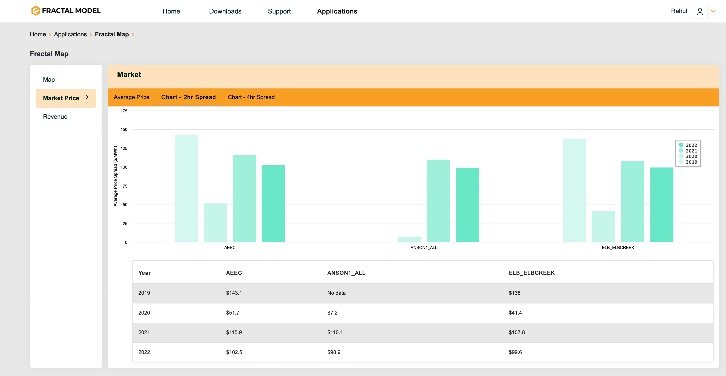
Fractal Maps
Visualize operational infrastructure and price data to find the best storage sites. Map transmission and distribution lines, power plants by fuel type and retail utility territories, and compare historical prices and potential BESS performance across markets.

Fractal Energy
Historical ISO data for energy, ancillary services, system load and generation, with custom dashboards for real-time monitoring and email or text alerts for critical events.
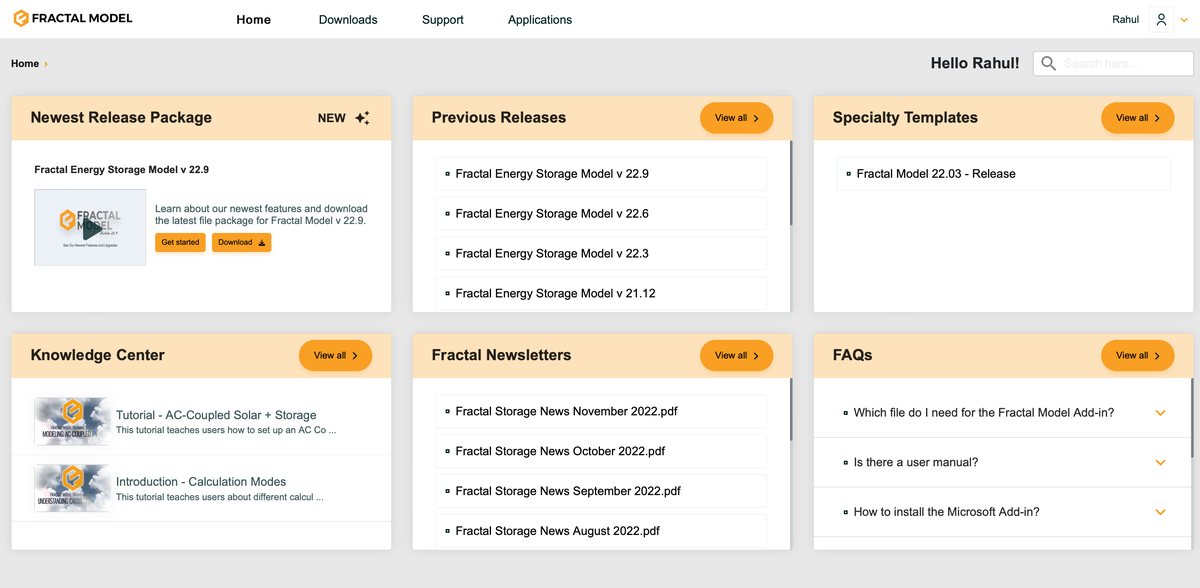
Fractal Portal
Download the latest release packages and specialty templates, and find tutorials, newsletters and FAQs in one place.
License Options
A company-wide annual subscription with two payment options. Contact us for a demo and pricing.
Annual Pre-Paid
- Unlimited users
- 15 support hours
- Fractal Model Excel and Add-In
- Fractal Portal and Fractal Maps
- Quarterly updates
- Training included
Monthly Payment
- Unlimited users
- 15 support hours
- Fractal Model Excel and Add-In
- Fractal Portal and Fractal Maps
- Quarterly updates
- Training included
Subscribers receive quarterly updates. View Release Packages