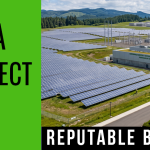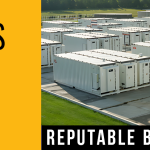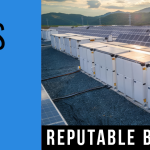
 Centrica has formally announced the completion of its 49MW Roosecote battery storage project, 18 months after construction started.
The energy major said construction of the project, one of Europe’s largest battery storage facilities, started in March 2017 and had now been fully unwrapped, just in time for Christmas.
The 49MW project is able to provide sub-second respond to fluctuations in demand and was among the 500MW of battery storage projects to have received a 15-year Capacity Market contract in December 2016 for the 2020/21 winter period.
Mark Futyan, distributed power systems director at Centrica Business Solutions, said: “The Roosecote site is truly unique, having been home to the latest technology of its time and is an exemplar of the transition we’ve made from dirty coal to cleaner, more flexible power. Christmas has indeed come early for our team!”
The site in Cumbria used to be home to a coal-fired power station that was later replaced by the country’s first combined cycle gas turbine.
It forms part of a £180 million (US$227.92 million) investment in flexible power on the part of Centrica, comprising a refurbishment and addition of a new gas turbine at the company’s King’s Lynn power station and two fast response gas-fired power stations.
read more Malta Inc., which started as “Project Malta” at the Moonshot Factory, but is now an independent company, announced Wednesday that it has raised $26 million in a round of funding led by Breakthrough Energy Ventures with participation from other investors including Concord New Energy Group, a wind and solar power developer, and Alfa Laval, a Swedish industrial company.
 Rooftop solar communities may soon become the latest line of cybersecurity defense for America’s vulnerable electric utility industry, providing emergency power for local consumers while supporting the grid in the event of an attack-based outage. Indeed, a key recommendation in a recent President’s National Advisory Infrastructure Council report on cybersecurity and the grid is that solar and other renewable energy-based microgrids be developed for emergency preparedness.
 Alphabet’s X division has played host to a string of experimental ideas, and another one is spinning out as an independent business. Malta uses cheap, abundant materials including salt, anti-freeze and steel to store power at grid scale.
 MIT researchers have demonstrated a new way to store unused heat from car engines, industrial machinery, and even sunshine until it’s needed. Central to their system is what the researchers refer to as a “phase-change” material that absorbs a large amount of heat as it melts and releases it as it resolidifies.
 For a subject that many have dismissed as too far into the future or not yet commercially viable, it seems there’s been a sudden change of heart.
 New York could support 27,400 energy storage jobs by 2030, according to a December report by the American Jobs Project and the New York Battery Energy Storage Technology Consortium (NY-BEST.)
 In the recently published “Energy Storage Inverter (PCS) Report 2018”, IHS Markit revealed its findings and forecasts for the fast growing sector.
 The vision of solar + storage, home automation and home building is coming to life in a small fishing community called Cortez, Fla., near the retirement and vacation communities of Sarasota and Bradenton. In Cortez, LEED residential developer Pearl Homes and sonnen, a market leader in smart residential energy storage, are teaming on a net-zero-plus and climate-positive community called Hunters Point.
 The New York State Public Service Commission (PSC) has approved two initiatives to dramatically increase New York’s energy efficiency and energy storage targets.