Fractal is Heading to InterSolar North America in San Francisco Next Week

on July 7, 2018

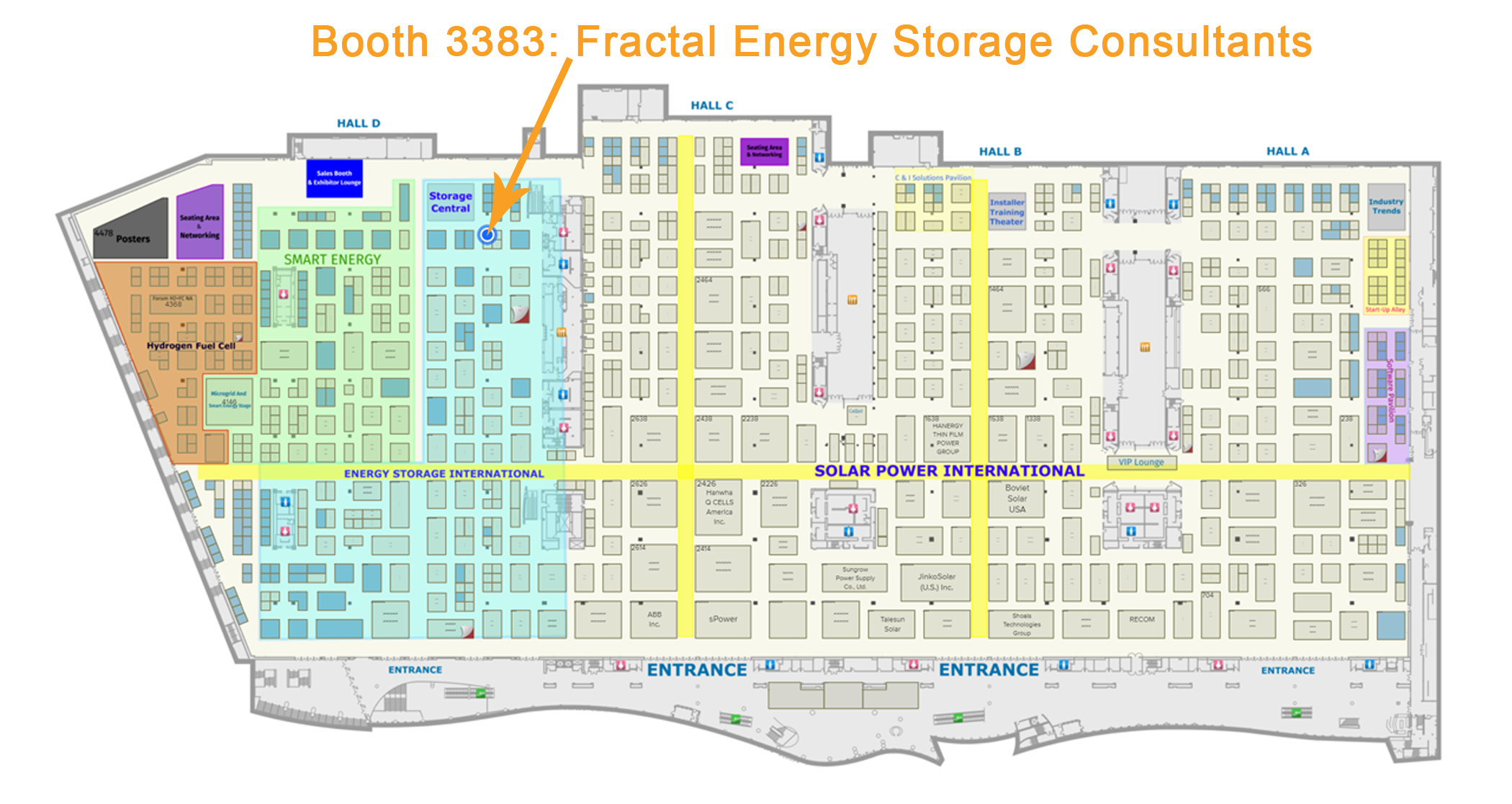
Fractal will be exhibiting at the 2018 Intersolar North America, July 10-12, 2018 at the Moscone Center West in San Francisco.

Intersolar North America is North America’s most attended solar event and premier networking platform. The event’s exhibition and conference both focus on the areas of photovoltaics, PV production technologies, smart renewable energy and solar thermal technologies. Since being founded, Intersolar has become the most important industry platform for manufacturers, suppliers, distributors, service providers and partners of the solar industry. Energy Storage International is co-located with Solar Power International and paves the way for greater integration between the energy storage and solar markets.

Fractal is a specialized energy storage and renewable energy consulting firm that provides expert evaluation, technical design and financial analysis of energy storage and renewable energy projects. Fractal is great resource for answering questions on all things storage. Come ask us some questions!

Contact Us to setup a meeting time. Hope to see you there!


read more
md-adminFractal is Heading to InterSolar North America in San Francisco Next Week

2018 Solar Power International / Energy Storage International – Sep 24-27, 2018

on July 7, 2018

Event Name: 2018 Solar Power International and Energy Storage International – Sep 24-27, 2018

Event Date(s): September 24-27, 2018

Event Location: Anaheim Convention Center, 800 W Katella Ave, Anaheim, CA 92802

Event Description:
Solar Power International (SPI) and Energy Storage International (ESI) generates success for energy professionals and the global solar industry. SPI sets the standard for solar events as the fastest growing and largest solar show in North America as recognized by Trade Show Executive and Trade Show News Network. SPI has also been among the Gold 100 for eight years running and named this year’s “Best Use of Technology” and the 2016 “Stickiest Show Floor” by Trade Show Executive for the innovative ways in which attendees stay engaged.

Under the umbrella of North America Smart Energy Week, SPI’s expanded scope to reflects the growth of energy innovation through the addition of ESI, Hydrogen + Fuel Cells North America, and the Smart Energy Microgrid Marketplace. ESI is the largest energy storage conference in North America, featuring over 160 energy storage exhibitors on the show floor, dedicated full conference education, show floor education in Storage Central and an exclusive storage networking event.

Find Fractal: Find Fractal in the exhibition hall at Booth 3383. Contact Us to set up a meeting time.

Event Website: https://www.solarpowerinternational.com/

read more
md-admin2018 Solar Power International / Energy Storage International – Sep 24-27, 2018

2018 AWEA Wind Resource & Project Energy Assessment Conference – Sep 11-12, 2018

on July 7, 2018

Event Name: 2018 AWEA Wind Resource & Project Energy Assessment Conference

Event Date(s): September 11-12, 2018

Event Location: Sheraton Austin Hotel at the Capitol, 701 E 11th St, Austin, TX 78701

Event Description:
Accurate wind energy resource assessment is a critical factor in the developing successful wind projects. Join the wind industry’s leading owners, project developers, wind assessors, and siting professionals in Austin, Texas for the annual AWEA Wind Resource & Project Energy Assessment. This technical event is the only one of its kind within North America. Attendees will participate in targeted networking sessions, explore the industry’s needs through presentations on new state-of-the-art techniques and technologies. As the conference concludes, attendees should expect to gain critical insight into the key matters by which the industry makes energy predictions.

Find Fractal: Find Fractal in the exhibition hall. Contact Us to set up a meeting time.

Event Website: https://www.awea.org/events/Event.aspx?EventID=61025

read more
md-admin2018 AWEA Wind Resource & Project Energy Assessment Conference – Sep 11-12, 2018

2018 Texas Renewable Energy Summit – Sep 5-7, 2018

on July 7, 2018

Event Name: 2018 Texas Renewable Energy Summit

Event Date(s): September 5-7, 2018

Event Location: Sheraton Austin Hotel at the Capitol, 701 E 11th St, Austin, TX 78701

Event Description:

Main Summit

The renewable energy market is exploding in Texas! 20.2 MW of utility-scale solar is projected to come online in ERCOT by 2031 and more than an additional 10 GW in wind. This makes Texas one of the biggest renewables opportunities in the country. Yet, success in the Texas marketplace won’t be a slam-dunk. In fact, the market is filled with plenty of uncertainty and risks. Where will the offtakers come from — and what are they looking for? What will the market fundamentals look like going forward and where are power prices headed? What will get built of the tens of thousands of megawatts in the ERCOT interconnection queue? Will additional transmission be built or will congestion become a growing problem? How do you put together economically viable, innovatively structured and ultimately long-term profitable projects? These are just some of the tough questions that challenge the renewables community. Those with the best market insight will be the players who succeed.

At the Texas Renewable Energy Summit, cities, municipal utilities, cooperatives, corporate offtakers, and retail electric providers will join the renewable energy community to get the latest insights into the Texas renewables market. It will be a valuable venue for:

  • Renewable buyers to share their needs and sellers to discuss potential solutions
  • Learning about the key trends shaping the Texas renewables market

Pre-Summit Executive Briefing:
The Fundamentals That Will Drive the Texas Renewable Market
Sharpen your game plan for the Texas market by delving into the market fundamentals that will shape the future of renewables in the state. The Briefing will assess the fundamentals and look at market design issues, transmission planning and other key elements to enable you to make good investment decisions.

Find Fractal: Find Fractal in the exhibition hall. Contact Us to set up a meeting time.

Event Website: http://infocastinc.com/event/storage-week/

read more
md-admin2018 Texas Renewable Energy Summit – Sep 5-7, 2018

Ajax’s Amsterdam Arena: Total Football Meets Holistic Clean Energy

on July 5, 2018

Energy-Storage-NewsOver one thousand days is a long time to spend on any number of things, let alone a single project for a commercial & industrial (C&I) customer. But when planning and building the largest commercial battery system using second-life and new modules in Europe, and when the customer in question happens to be the most successful club in the history of Dutch football, it seems that is the amount of time needed.

We know this thanks to the completion of the 3MW/2.8MWh energy storage system launched at Amsterdam’s Johan Cruyff ArenA last week, a project long in preparation and open now to great fanfare by the project partners.

Home to Ajax football club of the Dutch Eredivisie, the stadium hosts around 15 league home games a season as well as international ties, European cup encounters and a range of non-sporting events throughout the year. Keeping the lights on during these high profile events is of paramount importance, and offers the perfect application of energy storage.

The system – brought together by a power electronics company, a car company, an aggregator, a sustainable construction firm, and an arena – offers a new energy paradigm for the stadium. Charged from the 1MWp solar on the roof as well as some grid supply, the battery’s primary function is to provide uninterruptable back-up power to the venue.

The battery, charged to 100% for such events, can be called on to provide full power to the ArenA for one hour during a major event with maximum energy intake, or three hours if dispensable consumers (e.g. kitchen facilities) are disconnected.

Comprised of 250 second life battery packs with 340 first life battery modules from Nissan, controlled by four bi-directional inverters from Eaton and managed by a control system from The Mobility House, the system can also perform peak shaving during these high demand events to limit the impact on a constrained local grid system.

When not providing these functions, the system is leveraged to perform frequency regulation by charging or discharging batteries based on grid operator requests. Using its own generation from onsite solar, the system can also trade energy on the wholesale market while supporting the grid.

This kind of stack will be familiar to some but according to Henk van Raan, director of innovation at the Johan Cruyff ArenA, it offers specific advantages to the location.

read more

Fractal Energy Storage ConsultantsAjax’s Amsterdam Arena: Total Football Meets Holistic Clean Energy

Grid Neutrality is a Prerequisite For Energy Storage to Flourish

on July 5, 2018

euractivWithout energy storage, the EU target for renewable energy cannot be reached. And that can only succeed if the incentives for investment are set correctly and if “ownership unbundling” rules in the EU energy market are strictly enforced, writes  Dr. Hans Wolf von Koeller.

Dr. Hans Wolf von Koeller is Head of Energy Policy at STEAG GmbH, a German company which plans, constructs, and operates power plants and distributed energy facilities using fossil fuels and renewable energy sources. 

Did you know that The Landlord’s Game is the predecessor of the popular board game Monopoly? In 1903, Elizabeth Magie developed the Landlord’s game, and created two sets of rules for her game: an anti-monopolistic set in which all were rewarded when wealth was created, and a monopolistic set in which the goal was to create monopolies and crush opponents.

Monopoly is still fashionable, the design has changed and so has the owner of the trade mark. But the rules of the game itself are not for sale. The most powerful players cannot climb to new levels of dominance where they are able to gain control of the game.

So, is the energy system any different? Unbundling in the EU energy market was intended to create a kind of anti-monopolistic set of rules. Competition in a European energy market was meant to lead to lower prices for customers but also secure the supply of energy, especially electricity. At the core of unbundling is a strict separation of the natural monopoly at all grid levels from power production, supply to customers and load management.

However, these fundamental principles risk being endangered by the electricity market reform currently under discussion at European level. Under the upcoming Austrian presidency of the EU, the Council and the European Parliament are expected to agree on a set of rules that foster innovative solutions for new services to participate in the system, including electricity storage.

Yes, EU energy rules are under constant change. This alone is already challenging for all players. But the greatest threat is if the rule makers decide to allow the game board – the grid – to take an ever increasing part in the game.

read more
Fractal Energy Storage ConsultantsGrid Neutrality is a Prerequisite For Energy Storage to Flourish

Variable Speed Is Key To World’s Biggest Pumped Hydro Energy Storage Project, China’s Fengning Plant

on July 5, 2018

CleantechnicaFile this one under “I” for I’m not dead yet. The iconic US company GE has been weathering stormy seas of late, but its Power Conversion business is still alive and contributing to the renewable energy revolution. In the latest development, GE has just won a high profile contract to supply its high tech variable speed equipment for the massive new $1.87 billion Fengning hydropower and energy storage project in China’s Hebei Province, billed as the biggest facility of its kind in the world.

A Variable Speed Twist On The Old Pumped Energy Storage Tale

The roots of pumped hydro energy storage go back to the 19th century, but the technology really blossomed in recent years with the advent of renewable energy.

The basic idea is to use excess renewable energy to pump water uphill to a reservoir, which serves as a “natural battery,” sometimes called a water battery. When called for, the water is released to a hydropower plant downhill, which means that gravity does all the heavy lifting.

That’s just the basics. Getting the system to work with maximum efficiency is the tricky part.

Earlier this week, GE shared news that describes how the company’s variable speed technology will amp up the Fengning hydropower plant.

The Fengning plant has a capacity of 3.6 gigawatts. The pumped storage will add another 1.8 GW of capacity. Here’s the rundown on the role that variable speed drive will play:

Variable speed drive technology provides a full range of speed that is the best performing and most economical to pump water to the upper reservoir—when in the saving mode—or to release water to a lower reservoir to generate power.

GE’s contribution to the Fengning project will consist of two variable speed converters to match two generators provided by the company ANDRITZ Group, and one static frequency converter for four generators provided by China’s Dongfang Electric Machinery Co., Ltd.

Aside from greater efficiency, China is also counting on variable speed equipment and the Fengning plant to help ensure grid reliability during the Winter Olympics in 2022, when electricity consumption is expected to soar.

read more
Fractal Energy Storage ConsultantsVariable Speed Is Key To World’s Biggest Pumped Hydro Energy Storage Project, China’s Fengning Plant

Batwind is Connected and Masdar and Equinor Are Ready to Feed it Data

on July 3, 2018

Energy-Storage-News‘Batwind’, a much-talked about battery storage project due to being the first grid storage system connected to an offshore floating wind farm 25km off the Scottish coast, is now online.

In January, the project was described as holding great potential to learn from in showing how renewable energy could become a provider of baseload energy, by Statoil (now known as Equinor) and Masdar, two of the project’s partners which have committed to studying and analysing its performance.

The 1MW/1.3MWh ‘Batwind’ battery, designed and constructed by system integrator Younicos, is now complete and paired with ‘Hywind Scotland’, the floating offshore wind farm near Peterhead, Aberdeenshire.

“By adding energy storage capabilities to another world “first” – the world’s first floating wind farm – we hope to demonstrate the essential role that storage plays as we continue pushing the frontier in producing sustainable energy,” Younicos managing director Karim Wazni said.

“Specifically, we’ve equipped Batwind with our intelligent Y.Q software, which ensures that the battery ’learns’ the optimal storage conditions. Our software tells the battery when to store electricity and for how long, and when and how much to inject back onto the grid.”

Equinor has described the project as the first step towards a “scalable, global renewables energy storage system” and said it and Masdar are together developing the algorithms that instruct the system when to store power and when to send it to the grid. The software behind the algorithms will incorporate various data sources including weather forecasting, market pricing, maintenance, expected consumption data and how, when and if to provide grid services.

“Digitalisation is a key driver here. The more we feed Batwind’s power management system with data, the smarter it gets. In addition, Batwind can be utilised for other renewable energy sources including solar and onshore wind. We believe this will expand the market for all renewable energy sources,” Sebastian Bringsvaerd, development manager for Hywind and Batwind with Equinor.

read more
Fractal Energy Storage ConsultantsBatwind is Connected and Masdar and Equinor Are Ready to Feed it Data

The New Energy Storage Tech Gates, Bezos, Ma, and Branson Are Investing In

on July 3, 2018

SingularityA group of billionaires including Bill Gates, Jeff Bezos, Jack Ma, and Richard Branson have invested in Form Energy. The company, out of MIT, is designing a new type of battery, thought to be based on sulfur. If early reports of success turn into practical solutions, the technology could store energy for months at a time at a fraction of the current cost.

The Readily-Available Solution

Form Energy has so far been reticent to reveal the exact details of their new technology. However, Yet-Ming Chiang, an MIT professor and one of the company’s founders, has confirmed that one of the solutions it is pursuing is a “sulfur-flow battery.” Chiang described this technology in some detail in a scientific paper in 2017.

Flow batteries generally consist of two tanks containing some form of electroactive chemical elements. The liquid is pumped through a central charging chamber containing positive and negative electrodes (anode and cathode). This is where the energy storage and energy release process takes place. The chamber is separated in two by a membrane that ensures the liquids don’t come into actual contact with each other, as shown in the video.

The advantages of flow batteries include easy scalability and long cycle life. Among its disadvantages are relatively low energy density and high component cost.

Form Energy’s use of sulfur, which is both cheap and abundant, lowers those costs dramatically.

As described in PV-Magazine, the battery uses sulfur in the anode and aerated liquid salt in the cathode. Oxygen flowing in and out of the cathode makes the battery discharge and charge.

“This battery literally inhales and exhales air, but it doesn’t exhale carbon dioxide, it exhales oxygen. What this does is create a charge balance by taking oxygen in and out of the system,” Yet-Ming Chiang explained to PV-Magazine.

read more
Fractal Energy Storage ConsultantsThe New Energy Storage Tech Gates, Bezos, Ma, and Branson Are Investing In

Innovation Is Making Lithium-Ion Batteries Harder To Recycle

on July 2, 2018

As manufacturers make lithium-ion batteries as cheap as they can, they’re removing valuable elements that make them worthwhile to recycle, according to the Electric Power Research Institute.
EPRI assesses the end-of-life cost of batteries in a report it published at the end of last year. Last week, Ben Kaun, the program manager for EPRI’s Energy Storage Program, told members of the Illinois Commerce Commission that the lack of recycling adds an end-of-life cost to lithium-ion batteries.

“Currently in lead-acid 98 percent I think of those systems can get recovered and turned into new lead-acid batteries. It’s almost a fully closed loop,” Kaun told commissioners. “Lithium ion is not like that. There’s not the same kind of level of high-value materials, and a lot of the innovations going on right now in lithium-ion batteries are actually to drive out the remaining high value materials, like cobalt, out of the system.”

The cost of cobalt, which is used as a cathode material in batteries, jumped from $32,500 at the beginning of 2017 to $81,000 in March of this year, according to the Royal Chemistry Society. Battery manufacturers have responded by redesigning batteries to minimize cobalt. In May, Tesla CEO Elon Musk said the company had all but eliminated cobalt from batteries it uses in automobile and stationary batteries.

That keeps batteries cheap, possibly too cheap to recycle. Without valuable contents recyclers have little incentive to capture used batteries, Kaun said.

“Lithium-ion batteries have not yet developed the same kind of recycling infrastructure that have developed in lead-acid batteries,” he said. “There’s a significant issue that needs to be looked at here and how that recycling infrastructure is going to emerge. Part of it is scale. And part of it is understanding what the incentives are to develop that infrastructure and how you can also up-cycle or at least maintain higher grade battery materials that can be re-manufactured the same way lead-acid can be.”

Without a recycling market, battery owners are left with a disposal cost instead of a recycling incentive.

read more
Fractal Energy Storage ConsultantsInnovation Is Making Lithium-Ion Batteries Harder To Recycle